
Release time :2022-05-30
Source:support@yingchitech.com
Scan:2729
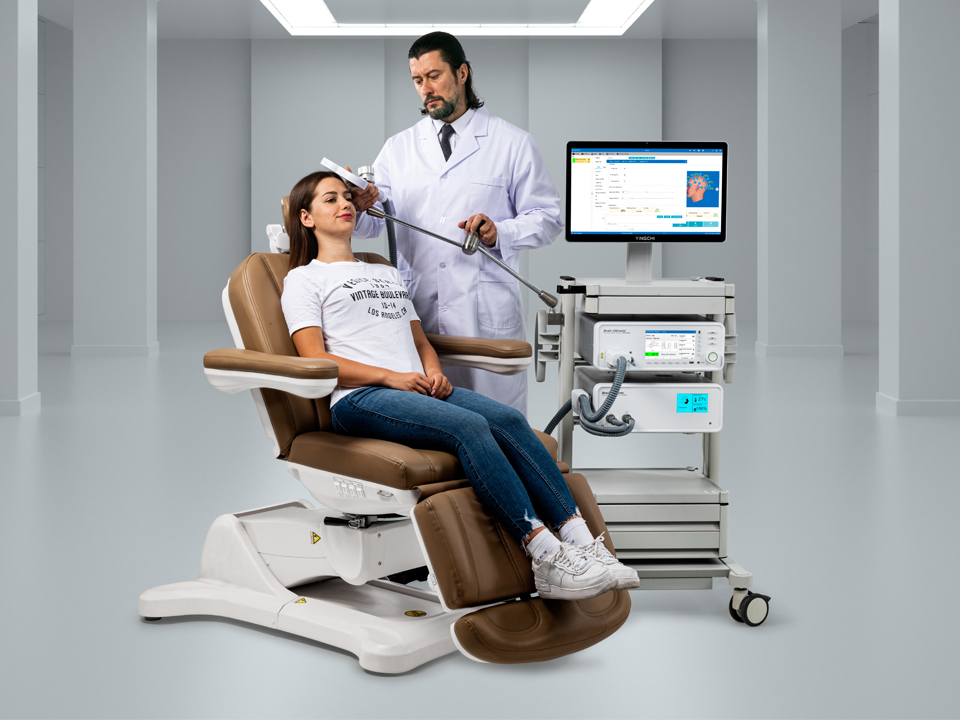
Transcranial magnetic stimulation (TMS) technology applies a time-varying pulsed magnetic field to penetrate the skull to form an induced electric field in the brain, thereby generating an induced current that acts on the nervous system, causing a series of physiological and biochemical reactions, affecting brain metabolism and changing neuronal excitability to improve and treat mental and neurological diseases.
As a new type of physical diagnosis and treatment technology, transcranial magnetic stimulation has received extensive attention on its safety and efficacy. At present, a large number of clinical trials of evidence-based medicine have proved its effectiveness. As transcranial magnetic stimulation becomes more and more widely used in clinical practice, it is crucial to understand its contraindications and precautions.
The safety guidelines for repetitive transcranial magnetic stimulation (rTMS) issued by the International Federation of Clinical Neurophysiology (IFCN) describe the contraindications and precautions during the use of transcranial magnetic stimulation.
1. The only absolute contraindication to TMS/rTMS is the presence of metal hardware (such as cochlear implants, internal pulse generators, or drug pumps) in close contact with the discharge coil. In this case, it is possible to cause such implanted devices to malfunction. NOTE: Cochlear implants include electrodes, magnets, loop antennas, and an electronic chip under the scalp.
2. When electrodes or implants are in the vicinity of the TMS coil, a risk analysis should be performed to assess the possibility of overheating. Electrodes made of silver and gold are highly conductive and can heat up significantly, potentially causing skin burns. 50°C for 100 seconds or 55°C for 10 seconds are enough to cause skin burns. Metal brain implants can also heat up. Brain tissue temperatures exceeding 43°C will cause irreversible damage.
3. Assess whether the implant is significantly affected by force or displacement. The magnetic field generated by the TMS pulse attracts ferromagnetic objects and repels non-ferromagnetic conducting objects. As a result, some head implants may be forced or even displaced by TMS.
4. The electromagnetic pulses of TMS can also damage the electronic implant near the coil. Vitro studies have shown that transcranial magnetic stimulation coils at a distance of 2-10 cm can lead to abnormal deep brain stimulation (DBS) implanted pulse generator (IPG) function, while distances less than 2 cm can lead to permanent IPG damage.
5. The risk of rTMS-induced seizures is extremely low. Even in groups of patients who are taking CNS-related medications, as long as traditional stimulation parameters and appropriate coils are used during treatment, the likelihood of epilepsy is minimal. However, for patients with: ① a personal history of epilepsy (one or several seizures in the past in untreated patients), or patients who have received treatment; ② cerebrovascular, traumatic, neoplastic, infectious, or metabolic lesions, even if no history of epilepsy and no use of anticonvulsants; ③ taking drugs that may lower the seizure threshold, but not taking anticonvulsants that may prevent seizures at the same time; ④ people with sleep deprivation and alcoholism need to consider the possibility of increased risk of seizure.
6. Skull defects are disabled.
7. Pregnancy, severe or recent heart disease, children < 2 years old, intracranial stimulation electrodes, cardiac stents, hearing impairment, epilepsy, elevated intracranial pressure, etc. are relative contraindications to TMS.
In conclusion, both in vitro and patient-specific studies suggest that transcranial magnetic stimulation can be safely administered to patients with implanted stimulators in the central or peripheral nervous system. For patients with pacemakers, vagal nerve stimulation (VNS) systems, and spinal cord stimulators, TMS is safe if the TMS coil is not activated in close proximity (10 cm) to electronic components such as an IPG located on the neck or torso. Care should be taken to avoid accidental discharge of the TMS coil near the electronic implant.
① Patients, subjects, and TMS operators should use appropriate and approved hearing protection (earplugs or earmuffs).
②Auditory evaluation of hearing loss, tinnitus, or ear fullness following TMS is recommended for any individual.
③ Individuals with pre-existing noise-induced hearing loss or concomitant treatment with ototoxic drugs (aminoglycosides, cisplatin) should undergo TMS after careful consideration of the risk/benefit ratio.
④The risk of increased hearing symptoms, although low, should still be considered when administering rTMS near the ear to treat tinnitus (or even auditory hallucinations) in patients with hearing loss.
⑤ Cochlear implants should not receive transcranial magnetic stimulation.
①Single pulse transcranial magnetic stimulation (sTMS) and paired pulse transcranial magnetic stimulation (ppTMS) are safe in children 2 years of age and older if appropriate hearing protection is used.
②For children under two years of age, specific hearing protection may be required due to the lack of data on the risk of hearing impairment.
③ For children one year old and below, due to the lack of safety data, the data on the hearing safety of TMS will have to be obtained first.
During prolonged stimulation, the operator's proximity to the magnetic coil (ie, less than 40 cm) should be minimized. The operator must use earplugs or earmuffs.
3. The operator needs to tell the patient the principle, process and possible response of the diagnosis and treatment to eliminate the patient's nervousness. Appropriate help is required for some physically disabled patients. For the elderly and children, the accompanying person needs to be informed of related information. Before treatment, patients can be asked to sign an informed consent form.
4. Before the patient's initial treatment, fill out the Transcranial Magnetic Stimulation Adult Safety Screen (TASS)
5. Remove any items that may be magnetized, such as credit cards, bank cards, magnetic card keys, magnetic disks, micro hard drives, etc., that you carry with you to the outside of the treatment room to avoid magnetization. Patients need to remove metal glasses, watches, hearing aids, etc.
6. A positioning cap can be worn to accurately select the stimulation site.
7. Choose the appropriate body position, sitting/supine position.
The safety screening questionnaire for transcranial magnetic stimulation
| 1 | Have you ever had an adverse reaction to TMS? | ? No ? Yes |
| 2 | Have you ever had a seizure? | ? No ? Yes |
| 3 | Have you ever had an EEG? | ? No ? Yes |
| 4 | Have you ever had a stroke? | ? No ? Yes |
| 5 | Have you ever had a a head injury (include neurosurgery)? | ? No ? Yes |
| 6 | Do you have any metal in your head (outside of the mouth,) such as shrapnel, surgical fragments from welding or metalwork? | ? No ? Yes |
| 7 | Do you have any implanted devices such as cardiac pacemakers, medical pumps, or intracardiac lines? | ? No ? Yes |
| 8 | Do you suffer from frequent or severe headaches? | ? No ? Yes |
| 9 | Have you ever had any other brain-related condition? | ? No ? Yes |
| 10 | Have you ever had any illness that caused brain injury? | ? No ? Yes |
| 11 | Are you taking any medications? | ? No ? Yes |
| 12 | If you are a woman of childbearing age, are you sexually active, and if so, are you not using a reliable method of birth control? | ? No ? Yes |
| 13 | Does anyone in your family have epilepsy? | ? No ? Yes |
| 14 | Do you need further explanation of TMS and its associated risks? | ? No ? Yes |
| 15 | A positive screen is any `yes' answer, indicating further investigation by the clinician (but not indicating exclusion from TMS). |
References
1.Rossi, S. , Hallett, M. , Rossini, P. M. , & Pascual-Leone, A. . (2009). Safety, ethical considerations, and application guidelines for the use of transcranial magnetic stimulation in clinical practice and research. Clinical Neurophysiology, 120( 12), 2008-2039.
2.Sr, A. , Aab, C. , Sb, D. , Mb, E. , Cb, F. , & Jb, G. , et al. (2020). Safety and recommendations for tms use in healthy subjects and patient populations, with updates on training, ethical and regulatory issues: expert guidelines - sciencedirect. Clinical Neurophysiology.
3.A, J. C. K. , A, M. J. S. , & B, E. M. W. . (2001). A safety screening questionnaire for transcranial magnetic stimulation. Clinical Neurophysiology Official Journal of the International Federation of Clinical Neurophysiology, 112(4), 720-720.
4.Zeng Lingyun, Xu Yumei, Li Yi, et al. Quality evaluation criteria of transcranial magnetic stimulation for mental illness in Shenzhen under health emergency conditions [J]. Chinese Journal of Health Emergencies, 2020, 6(5):4.